

From Carlo Azeglio Ciampi’s legacy to Sergio Mattarella’s recognition: the people and partnerships that have shaped Venice International University.
By Umberto Vattani
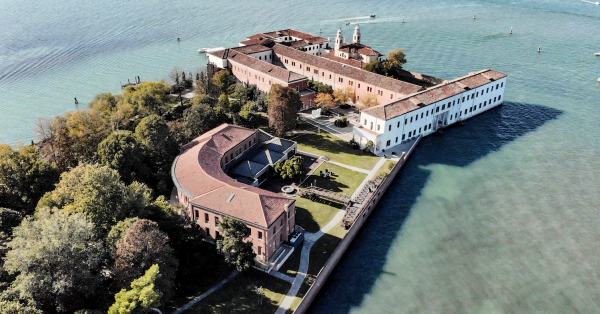
At a meeting in London of university presidents from the G20 countries, I listened to my colleagues discuss transnational education. Leading universities were opening campuses abroad, taking their courses, faculty and teaching methods with them. When my turn came, I explained that on San Servolo things worked the other way round. We were not taking our university to the world: the world was coming to Venice.
Universities thousands of miles apart sent students and professors to the same island, designed programmes together and shared a campus. None was a home campus; none was a branch. VIU belonged to them all because no single institution could claim it as its own. My colleagues looked surprised. None knew of another university built on that principle.
For sixteen centuries, Venetians have built on water, protected their shores and adapted the city to the lagoon without erasing it. Today, the seas are rising and the climate is changing. On San Servolo, we live with that challenge every day.
Carlo Azeglio Ciampi, VIU’s first president, asked me to succeed him when he became President of the Italian Republic. He was looking for a diplomat who could see beyond the interests of any one university. We had five member institutions then. But I wanted to do more than add names to a list: I wanted to bring the parts of the world we had yet to reach to the same table. We brought Asia and Africa alongside Europe and the United States, and welcomed two distinguished research institutions: Italy’s National Research Council, CNR, and its National Institute for Astrophysics, INAF. Today, we have twenty-three members on four continents.
From China to Global Challenges
Together with the Italian Ministry of the Environment, we began an extraordinary partnership with China that brought more than ten thousand environmental specialists and researchers to San Servolo. One was Chen Jining, then a young scholar at Tsinghua University. He went on to become China’s Minister of the Environment and Mayor of Beijing, and now holds the top leadership position in Shanghai.
The problems we face today do not fit neatly into academic departments. VIU brings different disciplines together. We have done so to address climate migration, population ageing and Covid. With the Council of Europe, we brought together young people from the Maghreb; with the OECD, we explored cities and tourism; through IILA, the Italian–Latin American Institute, we involved twenty Latin American countries. To mark the fortieth anniversary of the Montego Bay Convention, we brought the law of the sea back to Venice, with the participation of the United Nations Deputy Secretary-General.
Diplomacy Across Borders
With Ca’ Foscari, we put students to the test in simulations of the United Nations and the European Union. They represented countries other than their own and tried to reach agreements. Diplomacy came into the classroom.
Meanwhile, Arctic ice was retreating. New routes were attracting interest and stirring tensions. In Venice, we brought Europeans, Americans, Russians and Chinese together. With our universities, CNR and INAF, we convened scientists and diplomats to discuss the oceans, the Arctic and space.
Those conversations continued in Erice, at the Ettore Majorana Centre founded by Antonino Zichichi. For some sixty years, the Centre has welcomed scientists even from countries on opposing sides. There, we founded an international School of Science and Diplomacy.
Books and languages open routes of their own. With Ca’ Foscari and UNESCO, we are linking universities along Marco Polo’s routes. With IUAV and Sabancı University, we organised an exhibition devoted to Aldus Manutius: after Venice and Germany, it will travel to Mexico. With Italy’s Centre for Books and Reading, we launched translator residencies, taking up a thread that runs back to the dragomanni, the interpreters of the Venetian Republic.
To mark the five-hundredth anniversary of the Ghetto, Yiddish songs rang out on San Servolo. Behind the music lay stories of lives, sorrow and hope. When Kabul fell and the American University of Afghanistan could no longer operate in the country, we opened the island to its professors. From here, they continued teaching online to students scattered across the world, renewing Venice’s age-old tradition of welcome.
Pistoletto: A Plough for the Third Paradise
Today, art greets everyone who comes to the island. Arnaldo Pomodoro, Pietro Consagra, Marco Lodola, Mastroianni, Sebastian, Flavia Bigi, Carin Grudda and Oliviero Rainaldi have all contributed large-scale works. Fabrizio Plessi has transformed the university entrance with water, both real and virtual. Han Meilin has brought contemporary Chinese art to the lagoon through two pandas that welcome professors and students to San Servolo.
The first artist I invited was Michelangelo Pistoletto. I asked him for a new work. He asked me for a plough. With it, he traced the three circles of the Third Paradise in the soil for the very first time. The symbol has since travelled around the world. Pistoletto returned last year and proclaimed San Servolo the “Island of the Third Paradise”.
In the Palladian Refectory at the Giorgio Cini Foundation, Qin Feng spread out a canvas as large as the reproduction of Veronese’s The Wedding at Cana hanging before him. I told him that in 1797 the French had cut the painting into three sections to transport it to Paris. I suggested he do the same with his canvas. He tore it, and felt the pain of seeing the work he had just created ripped apart. In the very place where Veronese had painted The Wedding at Cana, Qin Feng experienced, through his own canvas, the wound inflicted on the Venetian masterpiece.
Telling the Lagoon’s Story
The lagoon also challenges us to make visible what the data reveal. Drawing on high-water measurements and MOSE technology, we created images and sounds that allow people to grasp the threat to Venice and understand how the flood barriers work. Science measures; art gives shape to what numbers alone cannot convey. Springer Nature has published the research that emerged from that experiment.
At the Osaka Expo, we presented a multimedia installation devoted to the Venetian archipelago, developed with the University of Padua and other scholars, with support from the Italian Ministry of Foreign Affairs. It tells the stories of islands, landscapes and communities. Venice does not end at St Mark’s Square.
At the Architecture Biennale, “Rome Is a Comet”, developed with IUAV, explored a different geography: from the great northern bend of the Tiber all the way to Rome’s coast.
Venice Renews Its Trust
The Metropolitan City of Venice gives VIU its home on San Servolo, provides hospitality and services, and works with us every day. Our Statutes recognise its role in welcoming the university to the island.
When President Mattarella received the heads of VIU’s member universities at the Quirinale, he singled out the originality of its founding idea. The Mayor awarded me the Lion of Venice. I took it as a personal honour, of course, but also as recognition of the place VIU has earned in the life of this city.
In London, I said we were bringing the world to Venice. That world is still coming. It studies, teaches, debates and creates. On San Servolo, it has also found refuge.
The island is small. The world it holds has grown immense.
Ambassador Umberto Vattani
President of Venice International University 2001-2026
Honorary President since 2026