


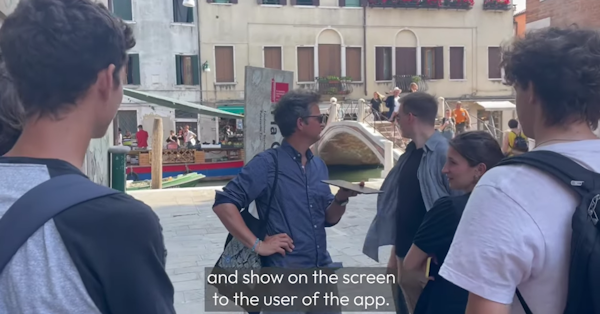
The Hidden Venice app was co-developed by Fabrizio Nevola of the University of Exeter, who is teaching at VIU in Spring 2026, to bring historical research to the broader public through immersive media.
The three trails - set in 1572, 1639 and 1730 - combine storytelling, with fictional historical characters describing the places and people they encounter along the way - and short articles that introduce historical background and context for each site, along with suggestions for further reading.
The Trails
City of Refuge (1572) - The historical character in this itinerary is Elena, a Greek migrant who has made a life for herself in Venice after fleeing the Ottoman expansion into Greece. Starting at San Zaccaria near Piazza San Marco, she takes you through the Castello district and introduces you to its migrant communities, with stories about the refugees, workers, merchants and scholars who made Venice their home.
Venice Unmasked (1730) - In this trail, you walk in the footsteps of Capitano Biancofior, who is investigating harassment of women while in a period when the city was trying to contain a libertine culture of gambling, seduction, and Carnival excess.
Boats, Bridges and Battles (1639) The guide in this itinerary is Sebastiano, an apprentice boatmaker who works at the Arsenale, the great shipyard of the Venetian Republic. Walking through Dorsoduro, listen to stories about the rivalry between boatbuilders and fishermen and the War of the Fists.
Students of the course Public Renaissance: Urban Cultures of Public Space between Early Modern Europe and the Present are working on a new trail that will be shared with the VIU community towards the end of the semester. You can see a video of the 2022 version of this activity here:
Fabrizio Nevola is the Professor and Chair of Art History and Visual Culture and was Deputy Head of the Department for Languages, Cultures and Visual Studies at the University of Exeter, where he is also co-director of Digital Humanities. He specialises in the urban, cultural and architectural history of Early Modern Italy, including a special interest in street life, and is involved in innovative work using digital art history approaches for research and public engagement.
Work on the project was carried out while Nevola was visiting professor at Venice International University for the Spring semester in 2022, and subsequently at Ca' Foscari, which is a partner of the project (Venice Centre for Digital and Public Humanities). Nevola was also a contributor to the Visualizing Cities Summer Institute at VIU.
The Hidden Venice app is part of the HistoryCity series - a suite of smartphone apps that present research-led itineraries in early modern cities as public history. Most recently with his team he has developed HistoryScapes, a collaboration with National Trust (UK).
The Book
Hidden Cities. Urban Space, Geolocated Apps and Public History in Early Modern Europe
Edited By Fabrizio Nevola, David Rosenthal, Nicholas Terpstra, Routledge, 2022
This Open Access collection explores the convergence of the spatial and digital turns through a suite of smartphone apps (Hidden Cities) that present research-led itineraries in early modern cities as public history, while considering how the medium structures new methodologies for site-based historical research, and also providing a platform for public history experiences that go beyond typical heritage priorities.
Hidden Cities is a valuable resource for upper-level undergraduates, postgraduates, and scholars across a variety of disciplines, including urban history, public history, museum studies, art and architecture, and digital humanities.