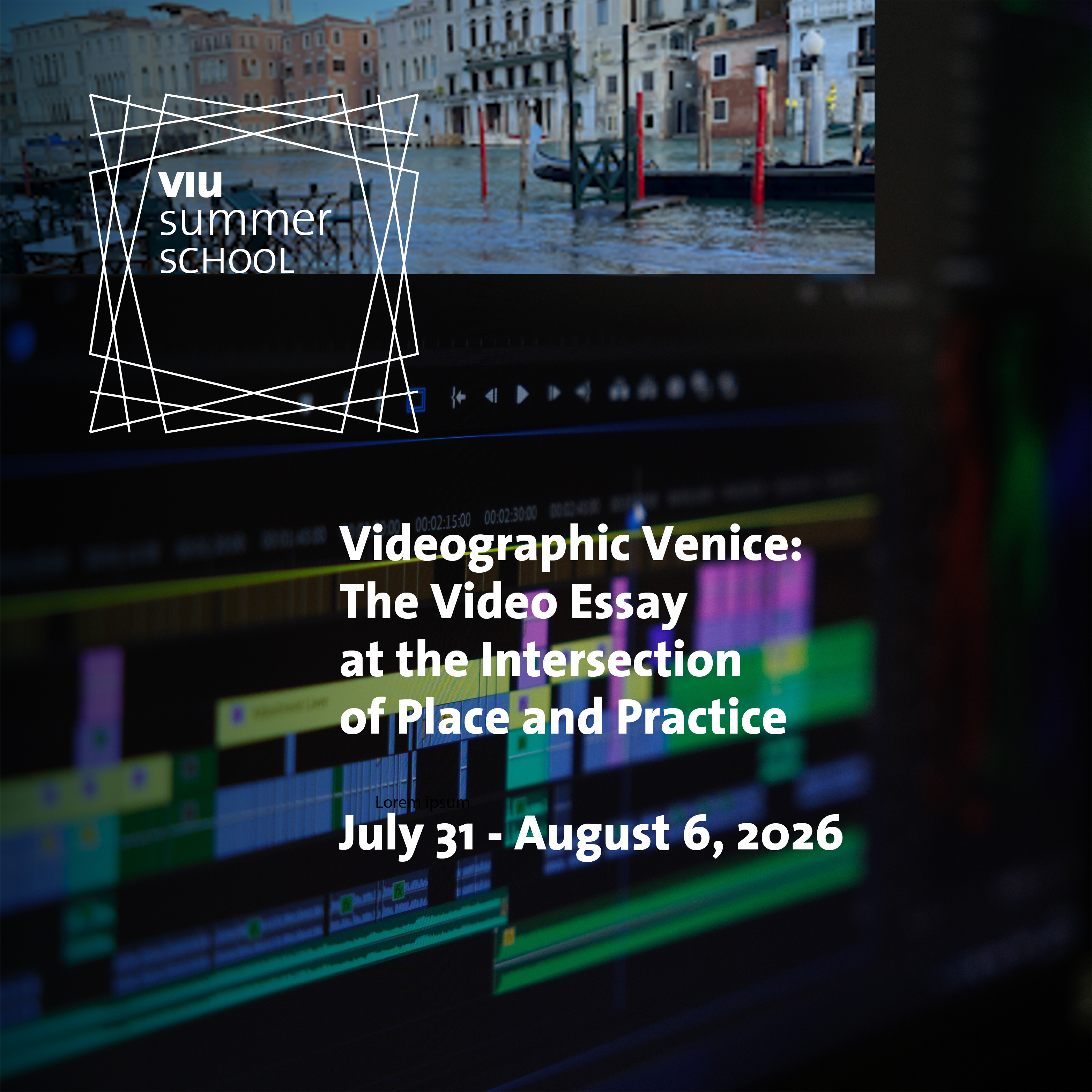
July 31 - August 6, 2026
1st edition
Call for applications: closed
VIU Scientific Coordinator: Danielle Hipkins, University of Exeter
Invited Scientific Coordinator: Barbara Zecchi, University of Massachusetts
What does it mean to create media in a city poised at risk of vanishing? What can the video essay do to preserve, reframe, and reimagine our relationship to vulnerable spaces, ecologies, and cultural heritages? Step into Venice, one of the world’s most fragile landscapes, not as a visitor, but as a videoessayist, and learn to navigate through delicate terrains. The city itself unfolds like a living editing timeline: canals as dissolves, narrow streets as cuts, archives as layered tracks, and emergent narratives as overlays—each frame waiting to be sequenced, juxtaposed, and brought into dialogue.
This workshop explores how the video essay can be a dynamic digital intervention to suture the fragments of past and present to imagine the Venice to come. Participants will cut, layer, reframe, and (re)produce the city to create and share knowledge across disciplines. Combining critical analysis with creative practice, we will engage with Venice as both subject and medium, using videographic methods to engage intellectually and emotionally with its layered histories, cultural resonances, and fragilities. Students will examine the city’s cinematic representations, explore video essays as landscapes of intellectual, spatial, and emotional experimentation, and reflect on the interplay between cultural heritage, social dynamics, and fragile ecologies. Designed for participants from diverse fields, and building on the success of prior international videographic workshops while taking advantage of Venice’s unique artistic, historical, and spatial contexts, the workshop fosters interdisciplinary collaboration, digital literacy, and innovative modes of thinking.
Contributing member universities:
- University of Exeter
- Tel Aviv University
- Ca’ Foscari University of Venice
Faculty:
Ariel Avissar, Tel Aviv University, IL
Johannes Binotto, Lucerne University of Applied Sciences and Arts, CH
Enric Bou, Ca' Foscari University of Venice, IT
Miriam De Rosa, Ca' Foscari University of Venice, IT
Danielle Hipkins, University of Exeter, UK
Colleen Laird, University of British Columbia, CA
Ohad Landesman, Tel Aviv University, IL
Alan O’Leary, Aarhus University, DK
Barbara Zecchi, University of Massachusetts Amherst, US
Which are the main activities?
3 online sessions (2 before and 1 after the workshop) and 7 working days in Venice that will include:
- Hands-on making sessions;
- Screening and discussion of work in progress;
- Mentor meetings (group or 1-1 meetings with senior maker overseeing projects);
- Presentation and discussion of theoretical/critical readings;
- Screening, presentation and discussion of exemplary video essays;
- Trips within city or locality and distinctive environments (as individuals, pairs, groups) to explore/record/film spaces and places of Venice.
Learning Outcomes
- Critical Understanding of Videographic Criticism: Participants will gain a deep understanding of the video essay as a form of critical inquiry, learning how to analyze, produce, and evaluate video essays that engage with complex themes such as place, space, and representation;
- Practical Skills in Video Essay Production: Through hands-on exercises, participants will improve practical skills in using audiovisual techniques to create video essays;
- Interdisciplinary Application: Participants will learn to apply videographic methods across various disciplines, using the video essay to explore themes relevant to fields such as film studies, architecture, art history, cultural studies, and urban studies;
- Engagement with Venice as a Site of Inquiry: Participants will engage directly with Venice’s unique spatial and historical contexts, developing video essays that reflect on the city’s role as both a physical space and a cinematic and cultural construct;
- Collaboration and Interdisciplinary Dialogue: Through group discussions and peer feedback, participants will engage in collaborative learning, sharing insights and approaches from different disciplinary perspectives, and fostering interdisciplinary dialogue around videographic criticism.
Who can apply?
This Summer School is open to participants of all levels - from graduate students to tenured faculty - and from any academic background, as the video essay is a versatile tool that can be applied across disciplines. Participants with familiarity in Adobe Premiere Pro or other editing software may find the learning curve easier and will be given priority. While the workshop will not provide step-by-step technical training in editing, participants will be guided through the process of making their own video essays. The workshop welcomes graduate students and scholars from Film and Media Studies, Communication, Digital Humanities, Visual Arts, Literature, History, Philosophy, Ecocriticism, Spatial Studies, Anthropology, Sociology, Gender Studies, and beyond. Anyone interested in engaging with audiovisual analysis and creative-critical methodologies as a mode of research, pedagogy, or artistic expression is warmly encouraged to join.
Credits
A Certificate of attendance will be issued at the end of the course.
Number of ECTS equivalence: 4
The Program will admit 20 participants.
Applicants must submit the application form and attach (1) a letter of motivation – which should include a short bio and a brief description of the applicant's interests in Videographic Venice and of what they hope to bring to a group working environment (600 words max) –, (2) a curriculum vitae, (3) evidence of videographic experience – please provide a link to what you consider to be your best videographic essay or, if your video is not online, please contact us to arrange a file transfer –, and (4) one reference (Name, Surname, affiliation, email).
Fees
Participants of VIU member universities: € 700 incl. VAT
Participants of other universities: € 1400 incl. VAT
The fees will cover tuition, course materials, lunches in the VIU cafeteria and social events.
Participants will be responsible for covering their own travel expenses to and from Venice, accommodation, local transportation and dinners. VIU Alumni are eligible for a reduced fee.
Limited scholarships may be available for participation fees, with additional grant support potentially covering accommodation (B&B) and on-campus dinners.
PhD candidates and post-docs from universities in EU universities may be eligible for Erasmus+ mobility grant support. Candidates should consult the International Office in their own university for information about the calls for applications for funding as well as for possible scholarships. VIU will provide any supporting documentation requested for such applications. Contact VIU Erasmus office: erasmus@univiu.org
Accommodation costs on campus
The cost of accommodation on VIU Campus for 8 nights, breakfast, municipal taxes and VAT included, is € 404 for a shared room (triple/quadruple) with other participants and € 684 for a single room. Further information will be available in the Application form.
For further information:
summerschools@univiu.org