


VIU hosts Boston College undergraduate summer schools, which give students of BC the opportunity to study Venetian civilization, religion, culture and art history on site during the month of June.
2016:
The Imaginary City: Why Writers Love Venice, Prof. Kevin Newmark
Drawing from the Venetian Masters, Prof. Alston Conley
Introduction to Law and the Legal Process, Prof. Richard Powers
2015:
Globalization, Culture and Ethics, Prof. Richard Keeley
The Imaginary City: Why Writers Love Venice, Prof. Kevin Newmark
Drawings from the Venetian Masters, Prof. Alston Conley
2014:
Globalization, Culture and Ethics, Prof. Richard Keeley
The Imaginary City: Why Writers Love Venice, Prof. Kevin Newmark
2013:
Drawing from the Venetian Masters, Prof. Alston Conley
2012:
Drawing from the Venetian Masters, Prof. Alston Conley
Venice: an Imperiled City in Comparative Perspective, Prof. Marc Landy
Introduction to Law & the Legal Process, Prof. Richard Powers
2011:
Dwelling Between East & West: The Philosophy of Architecture, Prof. Brian Braman
The Imaginary City: Why Writers Love Venice, Prof. Kevin Newmark
Venice: an Imperiled City in Comparative Perspective, Prof. Marc Landy
2010:
Drawing from the Venetian Masters, Prof. Alston Conley
The Imaginary City: Why Writers Love Venice, Prof. Kevin Newmark
Venice and New Orleans: A Comparative Study of Two Imperiled Cities, Prof. Marc Landy
VIU hosts Duke University undergraduate summer schools, which give students of Duke the opportunity to study Venetian civilization, religion, culture and art history on site during the month of June.
2016:
May 24 - June 25, 2016
Past editions:
2015:
Food for Thought: Understanding Italian Society and Culture through its food, Prof. Luciana Fellin
2014:
The Venetian Empire and its Imperial Piety: Catholic Christianity, Prof. Sam Miglarese
2012:
City and City Life in Italy, Prof. Valeria Finucci
2011:
The Venice of Our Imaginations, Prof. Marianna Torgovnick;
The Art of Politics and the Politics of the Arts: Music, Art and Politics in Northern Italy, Prof. Ken Rogerson
2010:
The Art of Politics and the Politics of the Arts: Music, Art and Politics in Northern Italy, Prof. Ken Rogerson
2008:
City and City Life in Italy, Prof. Valeria Finucci;
Venetian Art of the Renaissance (15th-16th Century), Prof. Maria Agnese Wiel
2007:
Venetian Art of the Renaissance (15th-16th Century), Prof. Maria Agnese Wiel;
The Venetian Empire (VXth & XVIth Centuries) and its Imperial Piety: Catholic Christianity and the role of the Virgin Mary, St. Mark, and the saint protectors of Venice, Prof. Sam Miglarese.
2006:
Policy and the Imagination - Music, Drama, Eros, and Liberty, Prof. Bruce Payne
Venetian Art of the Renaissance (15th-16th Century), Prof. Maria Agnese Wiel.
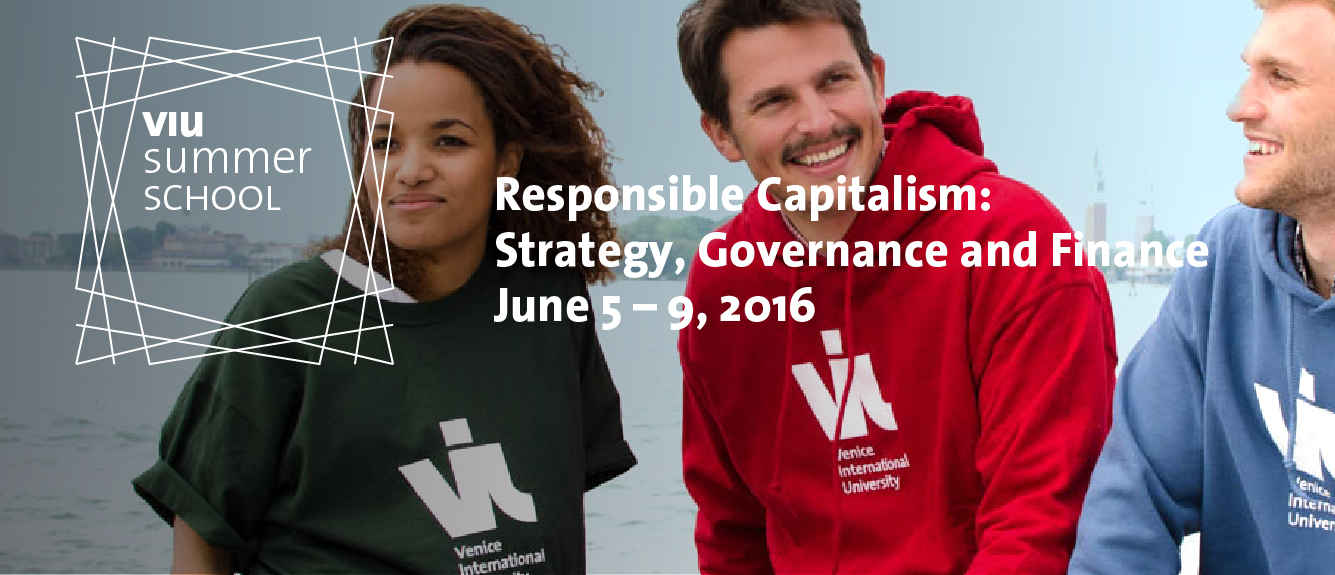
Duration and period:
June 5 – 9, 2016
Location:
Venice International University, Island of San Servolo, Venice (Italy).
The school is organized by Venice International University with the participation of professors from Università Ca' Foscari Venezia, Columbia University, IESE Business School, and University of Lausanne.
The program is designed to promote research and education on the future of capitalism in the light of current research in economic sociology, strategy, organization theory, finance, history and philosophy.
The school will provide a unique opportunity for researchers in the early stage of their career to interact with prominent scholars in the field and develop their own research projects.
Who is it for:
Applications are welcome from current Ph.D. students, research master’s students (e.g. MPhil students), post-doc researchers in Management, Strategy, Organization Theory, Finance, Economic Sociology, and related disciplines from universities worldwide.
Program structure:
The 5-day program will combine lectures, seminars, and developmental workshops.
In the morning, the state of the art in research will be discussed along with selected articles, including the presentation of the faculty’s own research work on the topics.
In the afternoon, participants will be invited to present their research ideas and, under the guidance of a senior scholar, they will develop their research projects.
The program starts on Sunday evening with a welcome reception and ends on Thursday afternoon with a site visit in Venice.
Program theme:
The growing gap between rich and poor, the social and environmental side effects of production and a regulatory vacuum around multinational production networks have forced new critical debate on our economic system. The School will therefore investigate sustainable capitalism from different angles: It will start by analyzing the ever more “postnational” constellation of capitalism, the potential roles and responsibilities of corporations in this changing societal context and sustainable corporate strategies. It will discuss the integration of environmental, social and governance factors (ESG) in traditional financial portfolio management and the concept of responsible investment. Finally, it will analyze one of the key complications of sustainability, namely the fact that it requires interdependent decisions and actions of multiple agents acting in a distributed environment. This circumstance alters both decision-making and the strategy implementation processes, and challenges the current governance and management conceptual toolkit available to scholars and practitioners.
Faculty:
##LIST##
##/LIST##
##LIST##
##/LIST##
##LIST##
##/LIST##
##LIST##
##/LIST##
##LIST##
##/LIST##
Faculty members will be at VIU during most days of the Program for one-to-one sessions, knowledge sharing, and networking opportunities.

Credits
A Certificate will be issued at the end of the course.
Number of ECTS credits allocated: 2
Application procedure and costs
The Program will admit 15 student participants.
There will be no participation fee and VIU will cover also accommodation at San Servolo Island campus and meals.
Student participants will be responsible for covering their own travel expenses to and from Venice and local transportation.
Online Application form (applications are now closed)
Deadline for submissions: April 3, 2016; admitted candidates will be notified by April 15, 2016.
For further information: elisa.carlotto@univiu.org

Deadline for applications: 30 May 2016
Coordinators:
Luca Pes, (History, Venice International University)
Shaul Bassi, (Literature, Università Ca' Foscari Venezia)
Visiting Lecturers
Natalia Mazur (Visual Studies, European University at St. Petersburg)
Nili Cohen (Contract and Comparative Law, Tel Aviv University)
Dominic Green (Political Science, Boston College)
Norimasa Morita (Film Studies, Waseda University)
Level of students and suitable fields of study
Preferably Master's and PhD students in the fields of Literature, History, Sociology, Political Science, Economics, but anyone motivated and interested may apply.
Number of students
min. 12 - max. 25
Course description
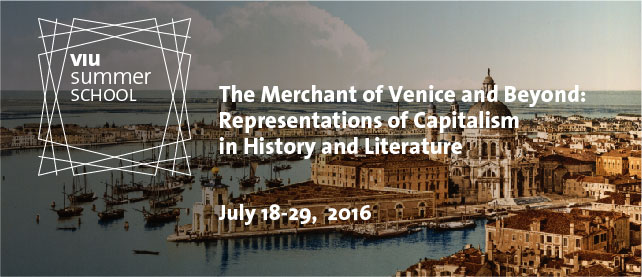
Shakespeare's The Merchant of Venice is regarded as one of the seminal literary documents connected to the development of venture capitalism in the early modern era. The association between Venice and trading, on the one hand, and Jews and moneylending, on the other, has made of this controversial play both a vehicle of antisemitic prejudice and a productive arena of discussion for these key issues that continue to be topical in the era of neoliberal globalization and of geopolitical crisis in the Mediterranean.
The aim of this program is to examine the multiple representations of capitalism in literature, history, and the arts, looking at different periods and texts to provide a comparative perspective, while taking advantage of the first historic performance of Shakespeare's play in the Ghetto of Venice (its ideal setting).
The course will also include site-specific activities that will highlight the role of Venice in different stages of the history of capitalism, from the age of mercantilism to the present state of global tourism. Literary and cultural texts will be read alongside economic and historical essays that both promote and criticize capitalism in its various forms, and popular culture will be used to represent example of local resistance to the pressure of global capitalism (Gualtiero Bertelli, Le Orme, Pitura Freska, Alberto D'Amico).
Topics:
Merchant capitalism and merchant republics
Images, interpretations, myths and anti-myths of Venetian capitalism and republicanism
Legal and economic aspects of The Merchant of Venice
The rise of the bourgeoisie and the spirit of modern capitalism
Interpretations of the decline of Venice
Literary representations of 19th Century capitalism
Monopoly capitalism, the fordist factory and imperialism
Images of capitalism in Russia (1861-1917)
Representations of imperial 20th Century Venice, Giuseppe Volpi and Fascism
Industrial Marghera, factory life, popular culture and workers' resistance
Globalization and the age of neoliberalism
Representations of Venice in the neoliberal and postindustrial era
Site visits include:
Guided tour of Palazzo Ducale
Guided tour of the Ghetto and Synagogues
Visit to the Biennale
Tour of the Arsenale
Lagoon Tour by boat
Texts under scrutiny will include Shakespeare's The Merchant of Venice, Dickens' Little Dorritt and Great Expectations, Friedrich Engels The Condition of the Working Class in England, John Ruskin's The Stones of Venice, William Dean Howells's Venetian Life, the life stories of the workers of the industrial port of Marghera (Venice) collected in Petrolkimiko (edited by Gianfranco Bettin), Goeff Dyer' Jeff in Venice, Death in Varanasi. Praises of merchants and enterpreneurs in both Venetian and non-Venetian ancient and modern contexts will also be considered. The texts will provide rival visions of capitalism as a creative force able to make history, bring development, create wealth and poverty, structure society, time and space, changing people's expectations and ideas, commodifying, wiping out old customs and transforming the environment. Each class shall deal with one of these themes. Each theme shall be dealt through the comparative analysis of literary and historiographic texts (canonical and contemporary) as well as a selection of accounts of the Venetian experience from the Renaissance to the present (literature, songs, historiography, life stories...).
Venice Ghetto 500
The program will coincide with the Quincentennial of the Jewish Ghetto of Venice and will include the first performance of Shakespeare's The Merchant of Venice, a seminal representation of the dynamics of modern capitalism, in the Ghetto. This course offers a unique contribution to a rich national and international program of cultural events, choosing as its distinctive perspective that of representations of capitalism in different texts, especially literary and visual, from the early modern to the postmodern, neoliberal era.
Learning outcomes of the program
Students will develop the ability to critically analyze and compare texts, from a specific point of view; will develop the ability to discuss in interdisciplinary, international context; will achieve introductory knowledge about varieties of ways in which capitalist relations have been imagined and described in different times of History and will be introduced to the history of Venice, from this particular angle.
Schedule
To be determined.
The program will mostly be seminar-type, alternating lectures, presentations, discussions and site-visits.
Bibliography
A part from the texts, which will be discussed in class and read in excerpts:
Joyce Appleby, The Relentless Revolution: A History of Capitalism, Norton, 2011
James Fulcher, Capitalism. A Very Short Introduction, Oxford UP, 2004
David Harvey, The Enigma of Capital: And the Crises of Capitalism, Profile Books, 2011
Credits
The program is equivalent to 3 ECTS.
Credit-seeking students who prepare a research paper or a creative project during the month following the Summer School, under the guidance of one of the program directors, will be awarded 6 ECTS. A final grade will be given, based on the paper or project (60%) and participation in class (40%)
A detailed certificate with complete information about the program will be provided
Fees (incl. 22% VAT)
Students from VIU’s member universities: €400 (also applicable to Alumni of VIU)
Students from other universities: €650
Others: €1000
The fees cover tuition, course materials, entrance tickets to museums and galleries (and guides) included in the program of activities, the welcome dinner and the farewell lunch.
Accommodation
Accommodation and other meals are not included. Upon request the VIU office will provide information regarding accommodation options on campus and in Venice.
Location
Venice International University is situated in beautiful grounds on the island of San Servolo, which is 10 minutes by boat from the San Zaccaria (adjacent to Piazza San Marco). It is served by the public transport system (no. 20 vaporetto/water bus). Some events will take place in other venues.
Campus services include a self-service cafeteria, a café, wifi, computer rooms etc.
Participants will have access to the VIU library.
For further information:
summerschools@univiu.org
Discover the projects that have been produced by the students during the past edition workshops of Visualizing Venice.
2013
The aim of the workshop, jointly promoted by Duke University, Iuav University of Venice and Venice International University, is to provide an introduction to a series of digital tools for the analysis, interpretation and visualization of data related to the shaping of man-made space. The final project is also available on: http://vimeopro.com/user10162055/the-ghetto-of-venice The workshop takes place in the Digital Lab on VIU Campus and the presentation of the final projects is held there at the end of every edition.
2012
The project by Dr. Dundas, Dr. Schmidt, Dr. Wallace and Dr. Groli constitutes a historical visual analysis of a new type of housing in 16th century Venice, that is to say the "casa doppia". The project focuses on the first example located in San Rocco which was equipped with an internal cistern, a private system to collect and filter water.
2012
The project by Dr. Di Stefano, Dr. Galeazzo and Dr. Moure constitutes a visual timeline of a particular cistern which is located in Campo dei Gesuiti showing its social importance and role in the different stages of the city.
2012
Visualizing Venice Workshop focused on "Venice Wells". This project is one of the 2012 edition outcomes.