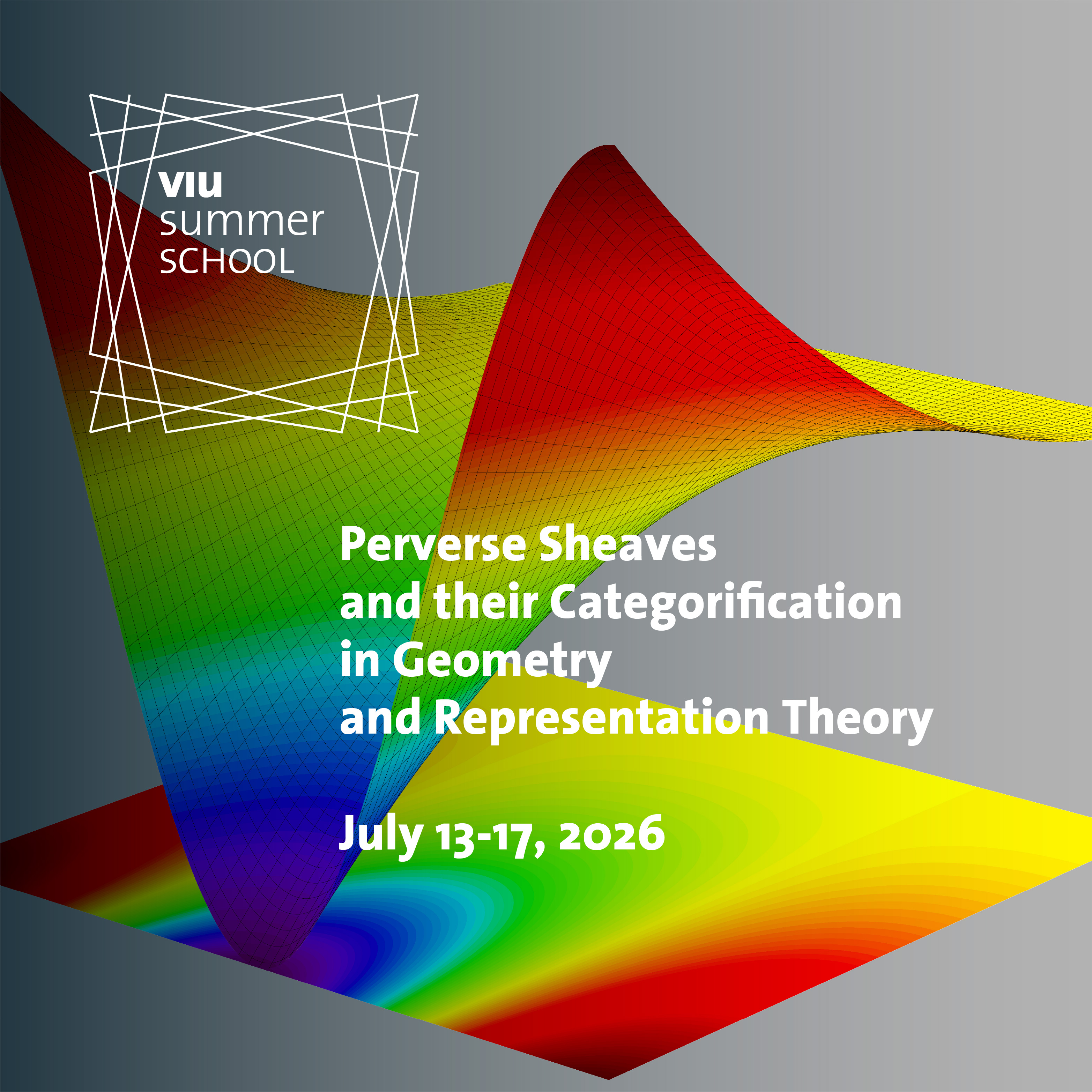
July 13-17, 2026
Call for applications: December 2, 2025 - March 15, 2026, via the VIU website
The use of perverse sheaves lies at the core of Geometric Representation Theory. It has allowed mathematicians to solve hard algebraic or representation-theoretic problems by identifying suitable spaces that encode crucial information and by using them to translate the initial problem into geometric terms. The aim of this Summer School is to introduce graduate students working in Algebraic Geometry, Representation Theory, or Topology to perverse sheaves and their categorification (perverse schobers), and some of their recent important applications.
The theory of perverse schobers represents a profound advancement in higher categorical geometry and representation theory. A perverse schober is a categorification of the classical notion of a perverse sheaf, replacing sheaves of vector spaces with sheaves of categories. This framework provides a powerful tool for studying moduli problems and categorical structures in algebraic and symplectic geometry.
Perverse schobers have found diverse applications across algebraic geometry, topology, and representation theory. For instance, they have been instrumental in the study of birational geometry and derived categories, particularly in the context of flops. They also play a key role in the study of the derived categories of quotient stacks from the viewpoint of Geometric Invariant Theory (GIT). Additionally, perverse schobers have been applied to classical problems, such as studying the non-rationality of certain varieties.
One of the most significant applications of perverse schobers lies in their connection to homological mirror symmetry, Fukaya categories, and cluster theory. These connections bridge algebraic geometry, symplectic geometry, and representation theory, revealing deep relationships between categorical structures and geometric phenomena. For example, perverse schobers provide a natural framework for understanding wall-crossing phenomena in mirror symmetry, further enriching the interplay between these fields.
The study of perverse sheaves, perverse schobers, and their interplay with geometry, algebra, and representation theory is currently an extremely vibrant and promising area of research. The techniques involved are highly sophisticated, making it challenging for early-career researchers to familiarize themselves with this rapidly evolving field without proper guidance.
Scientific Coordinators
Giovanna Carnovale, University of Padova
William Donovan, Tsinghua University
Francesco Esposito, University of Padova
Martina Lanini, Tor Vergata University of Rome
Francesco Sala, University of Pisa
Faculty
Agnieszka Bodzenta-Skibińska, University of Warsaw
Merlin Christ, University of Bonn
Francesco Esposito, University of Padova
Luisa Fiorot, University of Padova
Daniel Juteau, LAMFA UMR CNRS 7352, CNRS & Université de Picardie Jules Verne
Paul Wedrich, University of Hamburg
Who is it for?
The Summer School is intended for PhD students, early postdoctoral fellows and junior researchers, working in areas related to Algebraic Geometry, Representation Theory, and Topology.
Topics
- Derived categories and perverse sheaves
- Categories of Soergel bimodules
- Spherical functors
- Perverse schobers
Learning outcomes for participants
The theory of perverse sheaves and their categorification is extremely deep and sophisticated. This Summer School aims to raise awareness of the strength of the theory and equip participants with the necessary background and tools to engage with this topic during its period of rapid expansion.
Credits
A Certificate of attendance will be issued at the end of the course.
Number of ECTS credits allocated: 2
The Program will admit up to 30 student participants.
Fees
Students of VIU member universities:
€ 100 incl. VAT
Students of other universities:
€ 200 incl. VAT
The fees will cover tuition, course materials, lunches in the VIU cafeteria and social events.
Student participants will be responsible for covering their own travel expenses to and from Venice, accommodation, and local transportation.
VIU Alumni are eligible for a reduced fee.
20 scholarships are available to cover the accommodations costs on campus. Depending on the outcome of pending funding applications, additional resources may become available to support travel expenses. Students should indicate in the application form if they wish to be considered for these scholarships.
PhD candidates and post-docs from universities in EU universities may be eligible for Erasmus+ mobility grant support. Candidates should consult the International Office in their own university for information about the calls for applications for funding as well as for possible scholarships. VIU will provide any supporting documentation requested for such applications. Contact VIU Erasmus office: erasmus@univiu.org
Applicants must submit the application form, a letter of motivation – which should include a brief description of the candidate’s research interests, a curriculum vitae and a photo.
For further information, please download the brochure or write to: summerschools@univiu.org
This Summer School is supported by