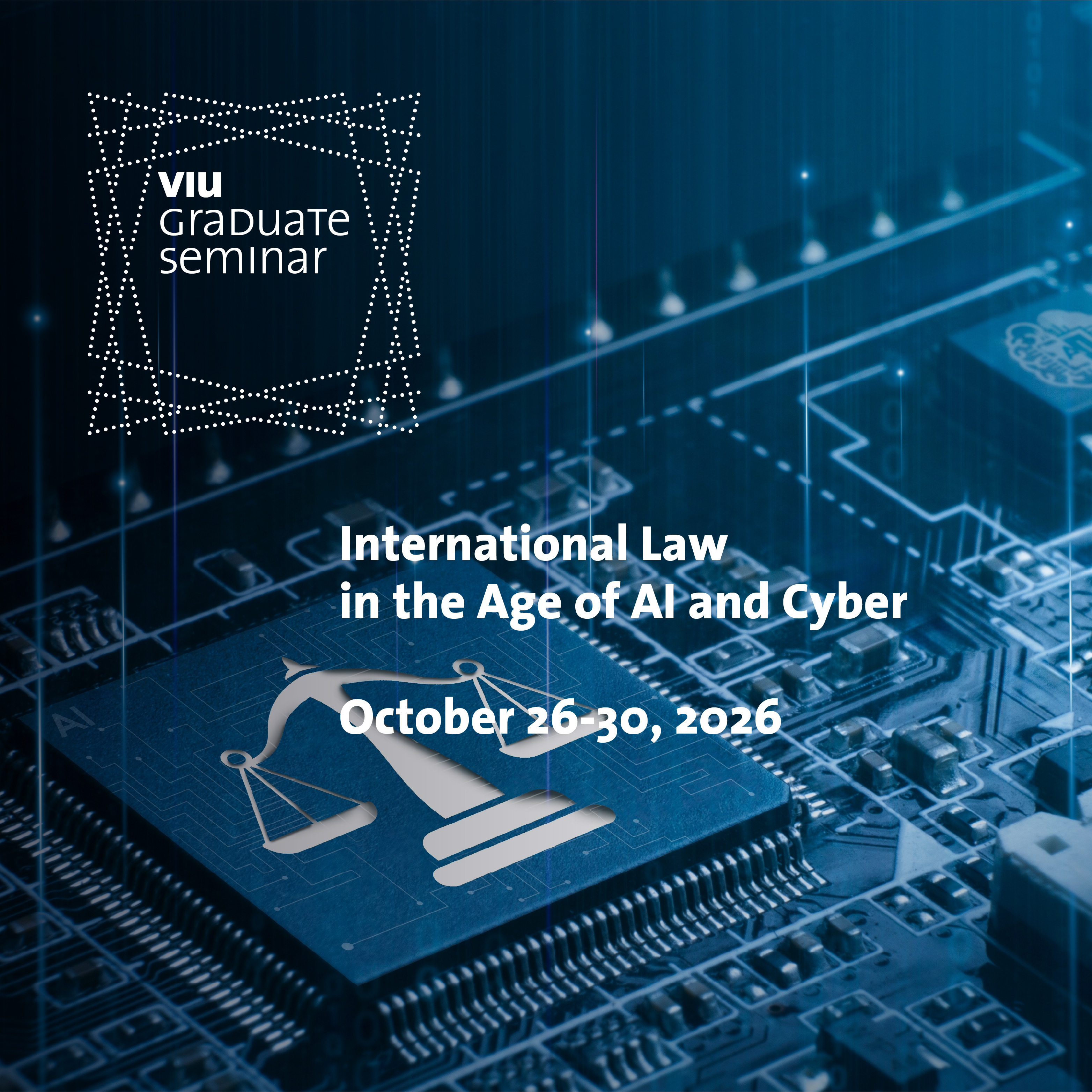
October 26-30, 2026
Call For Application: January 15 – June 25, 2026
The Graduate Seminar is led by:
- University of Padua, Italy
- KU Leuven, Belgium
- University of Exeter, UK
- Waseda University, Japan
In the last ten years, digitalization has been challenging fundamental categories of international law, such as State sovereignty (Lyall, 2022), use of force and nonintervention in internal affairs (Kilovaty, 2021; Duroy, 2023; Pijpers, 2023; Roscini 2024), and how they must be reconsidered and adapted to the digital domain (Tsagourias, Buchan, 2021).
In this regard, the Seminars will investigate the practice of States, especially their position papers on the application of international law to the cyber domain (Mačák, 2017), as well as the actions of international organizations, among them primarily the United Nations, which are striving to identify the content of applicable international law rules (Henderson, 2021, see also the outputs of the Group of Governmental Experts on Advancing responsible State behaviour in cyberspace and the Open-Ended Working Group on developments in the field of information and telecommunications in the context of international security).
As a final methodological remark, while the Graduate Seminars will focus, as explained above, on international law, they will also take into account the digital strategy of the EU, which has been a world-wide forerunner, in subjecting the use of AI to an intensive regulation, with the AI Act, which entered into force on 1 August 2024 (Regulation (EU) 2024/1689 of the European Parliament and of the Council of 13 June 2024; Pehlivan, Forgó, Valcke, 2024). This legal instrument, however, has been met with severe criticisms in some quarters of civil society and industries (Baldoni, 2023; Draghi, 2024, p. 79), as well as from some third states Governments (see e.g. the statement by U.S. VP J.D. Vance in Paris on 10 February 2025).
Faculty
Andrea Gattini, University of Padova
Gleider I. Hernández, KU Leuven
Mariko Kawano, Waseda University
Kubo Mačák, University of Exeter
Marco Dimetto, University of Padova
Aleksandra Kuczerawy, KU Leuven
Ana Beduschi, University of Exeter
Philippa Webb, University of Oxford
Andrea Crescenzi, National Research Council of Italy
Who can apply?
This Graduate Seminar is offered to Master students, PhD students, and junior researchers with a background in International Law, EU Law, Public and Comparative Law, Criminal Law, Human Rights Law, Cybersecurity Sciences, Political Sciences, and International Relations.
Open to candidates from all the VIU Member Institutions; applications from excellent candidates from non-member institutions will be also considered and evaluated.
Fees & grant support
Full fee waiver scholarships are available for students from VIU member institutions. In addition, grant support is available to support partially or fully the costs of international travel. Accommodation is provided free of charge. The participation fee for students of non-member institutions is Euro 1.150 VAT included. The fee is inclusive of tuition, course materials, accommodation, lunches, social events and taxes. Students from non-member institutions are not eligible for VIU grant support. VIU Alumni are eligible for a reduced fee.
Applicants must submit the (1) application form, (2) a letter of motivation – which should include a short bio and a brief description of the candidate’s research project, (3) a curriculum vitae, and (4) a photo.
For further information please download the brochure and the program or write to: summerschools@univiu.org